Literate Voices Summer Academy
Friendship Chapter Comic Strip Workshop
Essential Question:
How do friendships shape who we are?
Final Product:
A 6-panel Friendship Comic Strip for the anthology
Learning Targets
I can:
-
Describe a friend using specific details.
-
Tell a true friendship story using comic panels.
-
Use dialogue to show friendship.
-
Reflect on what a friendship has taught me.
8:30–8:50
Opening Discussion
What Makes a Friend?
Create a class chart:
Friends are...
-
Loyal
-
Funny
-
Honest
-
Supportive
-
Trustworthy
-
Kind
Discussion:
-
Who is someone you consider a friend?
-
What makes them different from other people?
-
What is one memory you share?
8:50–9:15
Teacher Model
Show your own Friendship Comic.
Example:
Friend: Sarah
Panel 1:
Meet Sarah.
Panel 2:
We met in 5th grade.
Panel 3:
We got lost on a field trip.
Panel 4:
Sarah stayed calm.
Panel 5:
We found our group.
Panel 6:
I learned real friends help when things go wrong.
Discuss:
Notice how the story is about one important memory, not every memory.
9:15–10:15
Friendship Planning Page
Students complete planning organizer.
Part 1: My Friend
Name:
Picture:
What makes this person special?
Describe:
-
Personality
-
Strengths
-
Habits
-
Interests
Part 2: Favorite Memory
What happened?
Who was there?
Where were you?
Why do you remember it?
Part 3: Reflection
What did this friendship teach you?
How has this person influenced you?
Why does this friendship matter?
10:15–10:25
Break
10:25–11:00
Dialogue Mini-Lesson
Show:
Instead of:
My friend is funny.
Use:
"You really thought that was the right way?" Maya laughed.
Practice:
Students write:
Three dialogue bubbles their friend might actually say.
11:00–11:50
Comic Storyboard
Students complete the Friendship Story Map slide.
Panel 1
Who is your friend?
Introduce them.
Panel 2
How did you become friends?
OR
Set the scene.
Panel 3
Beginning of memory
What happened first?
Panel 4
Middle of memory
What happened next?
Include dialogue.
Panel 5
End of memory
How was the problem solved?
What happened?
Panel 6
Reflection
What did you learn?
How did this friendship shape you?
11:50–12:30
Lunch
12:30–12:45
Comic Strip Demonstration
Model:
Adding:
-
Images
-
Speech bubbles
-
Thought bubbles
-
Captions
-
Sound effects
Review the three comic templates students already used for Family Chapter.
Students choose:
-
Traditional Comic
-
Graphic Memoir
-
Mixed Layout
12:45–1:45
Friendship Comic Creation
Students transfer storyboard to comic strip.
Requirements:
✓ Friend introduced
✓ One important memory
✓ At least 3 dialogue bubbles
✓ Reflection panel
✓ Images in every panel
✓ Title
1:45–2:05
Peer Review
Partners check:
□ Clear story
□ Friend described
□ Dialogue included
□ Reflection included
□ Easy to follow
2:05–2:30
Publishing Studio
Students:
-
Revise
-
Add color
-
Improve visuals
-
Complete title
Suggested titles:
-
My Best Friend
-
The Day We Got Lost
-
Through Thick and Thin
-
Always There
-
More Than a Friend
-
The Friend Who Changed Me
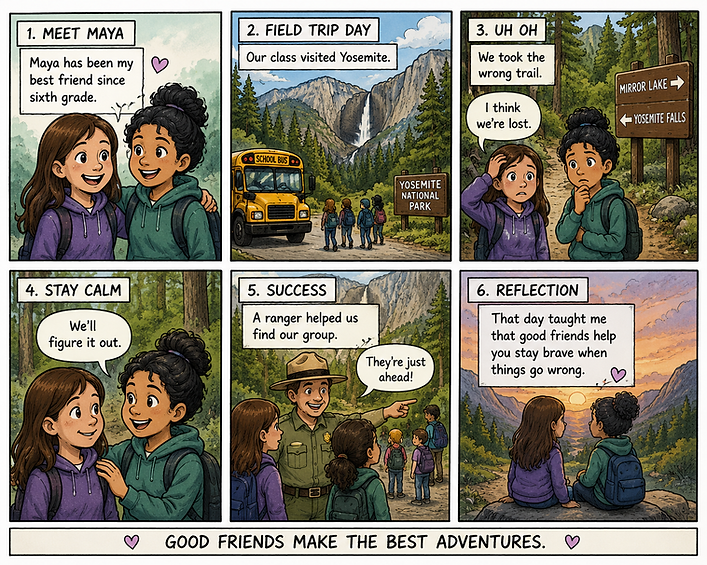
Example 6-Panel Friendship Comic
Panel 1
Meet Maya
"Maya has been my best friend since sixth grade."
Panel 2
Field Trip Day
"Our class visited Yosemite."
Panel 3
Uh Oh
We took the wrong trail.
Me: "I think we're lost."
Panel 4
Stay Calm
Maya: "We'll figure it out."
Panel 5
Success
A ranger helped us find our group.
Panel 6
Reflection
"That day taught me that good friends help you stay brave when things go wrong."